

Dear readers of my newsletter,
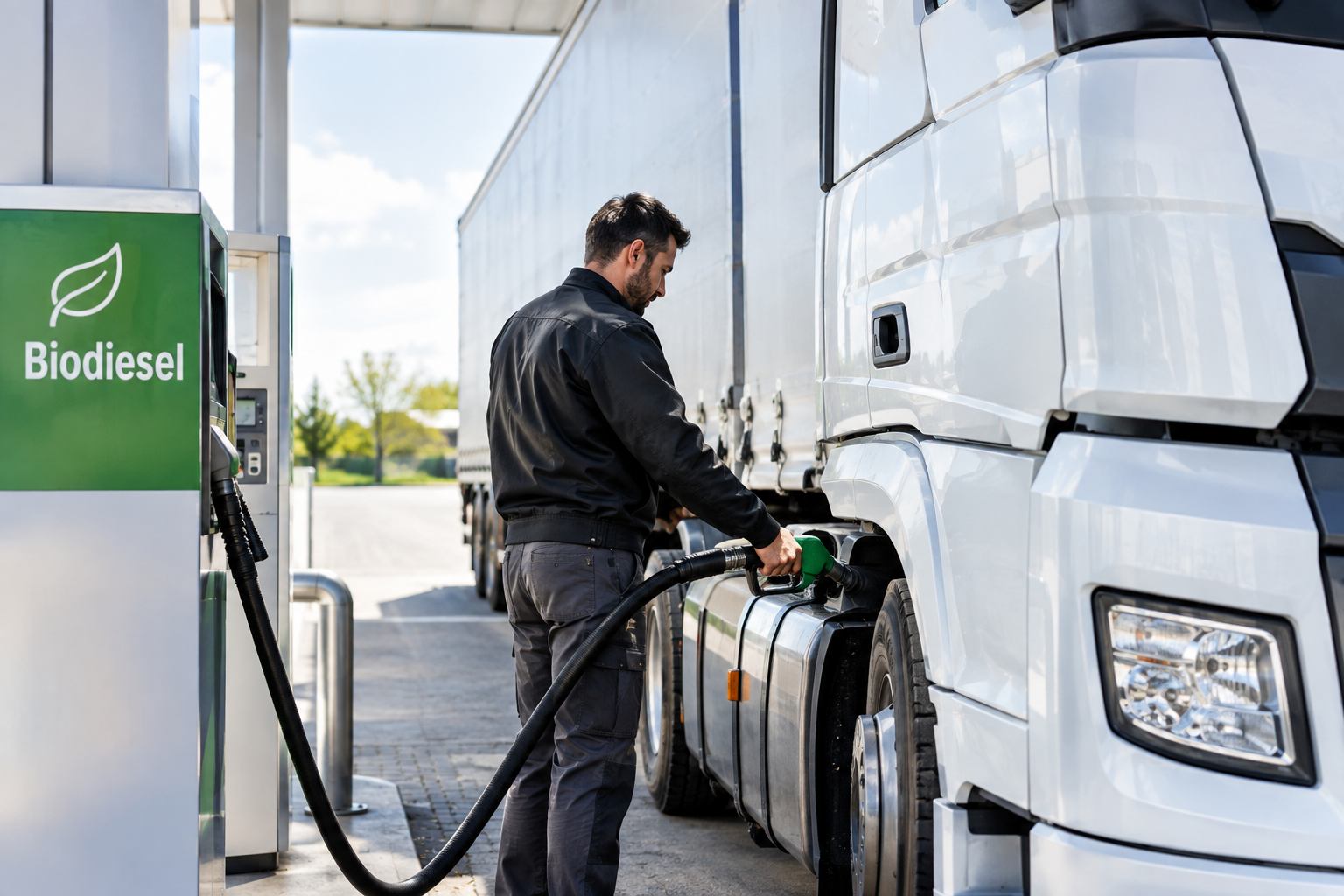
The IAA Transportation will take place in Hanover from 14 to 20 September 2026. Under the motto ‘Biodiesel: Higher Blends, Lower Costs’, the MVaK (Association of Small and Medium-sized Enterprises for Waste-based Fuels) will be represented alongside the VDB (Association of the German Biofuel Industry) and EWABA (European Waste-based & Advanced Biofuels Association). You are warmly invited to find out about the latest market developments, higher biodiesel blends (B10, B20, B30) and the use of pure B100 biodiesel in lorries and other commercial vehicles. Biodiesel is readily available, is produced domestically and can be used in many approved vehicles within existing fleets. Link to the press release: www.mvak.eu/presse/#pm08092026
In July, both soybean processing and corn consumption for ethanol production increased in the US, driven by favorable margins and solid demand. The USDA put the volume of soybean processing at 222 million bushels; this represents an increase of 4 million compared to June and 17 million compared to July of the previous year. Corn used for ethanol totaled 474.741 million bushels, an increase of 2% month-on-month and 4% year-on-year. Ethanol demand remains a key component of domestic corn consumption, while the increased soybean processing volume caused soybean oil and soybean meal inventories to rise above expectations. www.ufop.de
E20 is on the horizon: the fuel is expected to launch nationwide in Germany as “Super E20” before long.
The European Commission is currently evaluating whether higher ethanol content can be authorized; the current limit is ten percent. No specific launch date for E20 has been set. Within the industry, a timeframe starting in 2027 or 2028 is being discussed, contingent on regulations and standardization. According to Volkswagen, vehicles from the Volkswagen, Škoda, SEAT, Cupra, VW Commercial Vehicles, and Audi brands—dating from the 2016 model year onwards—are generally designed to run on E20. This includes high-performance models such as the Audi RS6 and Audi R8. However, there are limitations regarding specific variants of the 2.0-T(F)SI engines with outputs exceeding 221 kW (300 hp). BMW and Mercedes-Benz are also preparing their engines for higher ethanol levels. If E20 hits the market, the requirement to stock conventional premium gasoline could be dropped, given the limited number of fuel nozzles available at gas stations.
The question remains whether German drivers are willing to accept higher ethanol levels in their cars. Past experience suggests skepticism, as a fuel with increased bio-content has long been available: E10 has been widely sold in Germany since 2011. Although the *Bild* newspaper disparaged it as “eco-slop” right from the start, E10 has only managed to capture a 28% share of the gasoline market after all these years. Conventional E5 remains the dominant choice, despite usually costing six cents more.
A look at Austria shows that things can be done differently. There is no statutory requirement there to stock specific fuel types. For decades after E10 was introduced in Germany, Austrian gas stations sold only E5. Then, in April 2023, the switch to E10 happened practically overnight. It happened just like that, without any public outcry—and without engines failing en masse. So, do people across the border view their vehicles with less affection than we do here? Martin Grasslober, Head of Transport Economics at the Austrian automobile club ÖAMTC in Vienna, categorically denies this. However, he notes that Austria was able to build on the fact that E10 was already well-known and manufacturers had long since finalized their compatibility lists.
Despite its superior climate footprint compared to purely fossil-based fuels, the Green Party in the Bundestag—of all groups—views the prospect of more ethanol in fuel tanks with skepticism. “This is a step in the wrong direction,” criticizes Bavarian Green MP Karl Bär, who handles this issue within the Bundestag’s Committee on Agriculture.
Uniper has signed various contracts—including agreements with Siemens Energy and Topsoe—to launch the next development phase for NorthStarH2. NorthStarH2 is a planned e-methanol production facility in Östersund, Sweden, designed to help decarbonize sectors such as transport and the chemical industry. The facility will use renewable electricity and biogenic carbon dioxide to produce fossil-free e-methanol, with an anticipated annual output of approximately 115,000 tonnes. Uniper and the contracted companies will now determine the facility’s technical design and prepare the project for the construction phase as part of the FEED (Front-End Engineering Design) stage. Commissioning is currently scheduled for 2031. Read more at: https://afry.com/en/newsroom/news/afry-selected-lead-engineering-unipers-northstarh2-e-methanol-plant
Sunoil Biodiesel has received approval to supply sustainable biofuels in Belgium, thereby expanding the number of European markets in which the Netherlands-based producer operates. The company manufactures biofuels from waste materials—such as used cooking oil—at its facility in Emmen and is already active in the ARA marine fuel market. Sunoil recently formed partnerships with Verde Marine Energy and IJsselland Biofuels to supply B100 marine fuel; additionally, the company retrofitted a Dutch inland vessel to run on 100% biodiesel. This expansion strengthens Sunoil’s European distribution network for certified sustainable fuels. For more information, visit the website: https://biofuels-news.com/news/sunoil-biodiesel-gains-belgian-approval-as-european-expansion-accelerates/
ORLEN has joined forces with 13 energy companies and organisations from Northern and Central Europe to launch the ‘Baltic Energy Initiative’. The partners will work together on projects aimed at strengthening energy security and competitiveness across the region, focusing on offshore wind power, LNG and bio-LNG, hydrogen, carbon capture and storage (CCS), nuclear power and small modular reactors (SMRs). The Baltic Energy Initiative serves as a platform for pooling expertise, exchanging experience and jointly developing projects with an international scope. The partners will also cooperate in securing funding from European Union programmes and other international sources. Read more at: https://infra-be.com/orlen-joins-regional-energy-partnership-to-accelerate-baltic-energy-projects/
Indonesia is advancing the rollout of B50 biodiesel; this fuel blend, featuring a higher biodiesel content, is now reaching most Pertamina service stations as the government further develops its program to increase domestic palm oil usage in the transport sector. The initiative aims to reduce reliance on diesel imports, strengthen energy security, and boost the uptake of domestic palm oil production. This move follows the transition from B35 to B40 and underscores the government’s commitment to making B50 a key component of its fuel strategy. The program could significantly increase domestic demand for biodiesel while simultaneously supporting the local palm oil industry. More at: https://biofuels-news.com/news/pertamina-launches-nationwide-b50-biodiesel-distribution-across-indonesia/
The Swiss company Kanadevia Inova has been awarded a contract to build a waste-to-energy plant in Casablanca capable of processing approximately 1.5 million tonnes of non-recyclable waste annually. According to the report, the project is part of a 33.5-year concession agreement between the Casablanca municipal authorities and a consortium comprising Nareva, Kanadevia Inova, and Itochu Corporation. The facility is set to be built northwest of the Mediouna landfill in the Casablanca-Settat region and will convert waste into electricity; the report adds that the expected generation capacity is 126 megawatts. More at: https://kanadevia-inova.com/discover/news/571be44c-b33b-4a3c-af8d-46438b1b0cf1
Haffner Energy announces the launch of a new energy solution for data centers that is already the subject of initial commercial proposals. The company aims to address three challenges critical to data center development: the rapid provision of high electrical power with high efficiency and no additional grid load, the decarbonization of energy supplies, and the management of water requirements. Haffner Energy’s value proposition is based on compact, standardized, and cost-effective C-iB modules. Developed from the C-iC, the C-iB module is specifically designed for multi-module plants; this enables the sharing of certain functions, a significant increase in production capacity per module, cost reductions, and the simultaneous production of biochar. Read more at: https://www.datacenterdynamics.com/en/news/haffner-energy-launches-biomass-power-cooling-system-for-data-centers/
The biotechnology company ÄIO and the research institution TFTAK have launched “DigiFoundry 2.0 – Bioprocess Efficiency Increase via Digitalization” (DF2.0)—a three-year research and development project aimed at creating next-generation technologies for microbial oil production. The project is receiving €1.94 million in funding under the Applied Research Programme of the Estonian Business and Innovation Agency, with a total budget of approximately €2.53 million. ÄIO’s project ranked first among the applications approved in the program’s tenth funding round. The Applied Research Programme is funded by the Estonian Ministry of Economic Affairs and Communications. More at: https://www.specialchem.com/cosmetics/news/aio-tftak-secure-eur1-94m-to-scale-up-precision-fermentation-of-microbial-oils
Kazakhstan plans to build its first facility for the production of sustainable aviation fuel (SAF). The US company KBR has been awarded a contract by KMG-Aero—a subsidiary of KazMunayGas—and KazFoodProducts to provide technology and engineering solutions for the new plant. The planned facility will utilize the PureSAF technology developed by Swedish Biofuels. According to the report, this technology is based on the “Alcohol-to-Jet” (AtJ) process, which enables the production of aviation fuel from alcohol-based feedstocks. PureSAF is a feedstock-flexible technology designed to achieve high SAF yields. The company will license the technology and supply its proprietary technical plant design. More at: https://bioenergytimes.com/kazakhstan-advances-first-sustainable-aviation-fuel-project-with-new-agreements/
The Fraunhofer Institute for Environmental, Safety, and Energy Technology UMSICHT, the Fraunhofer Institute for Applied Polymer Research IAP, and the South Korean energy company SGC Energy are pooling their expertise to further develop processes for CO2 utilization and hydrogen production, as well as battery and fuel cell technologies. To this end, the partners have signed a memorandum of understanding. The collaboration focuses on the development and scaling of electrochemical technologies for industrial application. As a leading player in the South Korean energy sector and the field of carbon capture, SGC Energy plays a pivotal role as an industrial partner and future user of the technologies under development. The company plans to leverage existing carbon capture facilities and industrial infrastructure to establish an electrolysis platform for producing sustainable fuels and basic chemicals. With its carbon capture infrastructure, extensive experience in energy supply, and strong engineering expertise, SGC Energy creates the essential conditions for evaluating new technologies—regarding both technical feasibility and economic potential—at an early stage and advancing them for industrial use. Read more at: https://www.iap.fraunhofer.de/en/press_releases/2026/new-partnership-co2-technologies-hydrogen-batteries.html
In 2026, Singapore will launch a pilot project to test the feasibility of carbon capture technologies at its waste-to-energy plants. According to the report, this process for eliminating residual emissions—in which carbon dioxide generated during industrial processes is captured and stored elsewhere before being released into the atmosphere—is one of several strategies the government is evaluating as part of its goal to achieve net-zero emissions by 2050. Read more at: https://www.edb.gov.sg/en/news-and-insights/singapore-to-pilot-carbon-capture-and-storage-technology-at-waste-to-energy-plants
Rolls-Royce has announced that it has received the “Methanol Readiness Certificate” from the international classification society DNV for its current Series 4000 mtu marine engines. With this certification, DNV validates the technological concept of enabling newly built Rolls-Royce marine propulsion systems to be converted for dual-fuel operation with methanol in the future. The uncertainty surrounding future CO2 regulations is driving a desire among many ship operators for greater flexibility regarding propulsion and fuel. The Methanol-Ready certificate gives customers the assurance that they will be able to operate their vessels on methanol once the fuel becomes sufficiently available. Read more at: https://www.mtu-solutions.com/eu/en/pressreleases/2026/Rolls-Royce-receives-methanol-ready-certification-for-mtu-engines.html
The Chunta Aragonesista (CHA) and the Greens in Aragon are calling for a six-month moratorium on new biogas and biomethane plants while regional authorities develop stricter planning and regulatory standards. The parties cite concerns regarding environmental impacts, the handling of digestate, the origin of waste, and proximity to residential areas—issues arising from the rapid proliferation of around 75 projects across the region, including 31 in the province of Huesca. Proposed measures include a public project registry, limits on plant density, more rigorous environmental impact assessments, controls on waste transport, and greater public involvement. Read more at: https://advancedbiofuelsusa.info/cha-and-the-green-party-are-calling-for-a-moratorium-on-biogas-and-biomethane-plants
Louis Dreyfus Company (LDC) is building an industrial facility in São Paulo, Brazil, to produce biogas from citrus processing wastewater. Spanning an area of over 186,000 square meters, the project addresses one of the orange juice industry’s most significant waste streams by converting organic wastewater into a source of clean, renewable energy. Designed to handle massive volumes of industrial waste, the facility processes approximately 378,000 liters of citrus wastewater per hour. Utilizing specialized biotechnology and advanced inoculant cultures, the system is engineered to efficiently break down the high organic load present in the wastewater. At full capacity, this biological degradation process is expected to yield more than 50,000 cubic meters of biogas daily. Read more at: https://www.bioenergy-news.com/news/ldc-builds-citrus-effluent-biogas-plant-in-sao-paulo/
France is preparing to launch the second round of its national support program for the production of renewable and low-carbon hydrogen, targeting an additional 250 MW of electrolyzer capacity. The Directorate General for Energy and Climate (DGEC) announced that the launch is “imminent,” with the selection of eligible projects expected to take place in early September. Selected applicants will subsequently be asked to submit their final bids by the end of 2026. France concluded the first round in July, awarding $856 million in funding—spanning a 15-year term—to three projects. https://renewablesnow.com/news/france-to-launch-250-mw-second-round-of-clean-hydrogen-auction-1300488/