

Dear Readers,
If renewable energy is growing at record speed, why do our economies remain so heavily dependent on fossil fuels? Renewables have the potential to make economies more energy-independent, resilient, and prosperous. Yet, the systems required for a renewable-based economy do not yet exist.
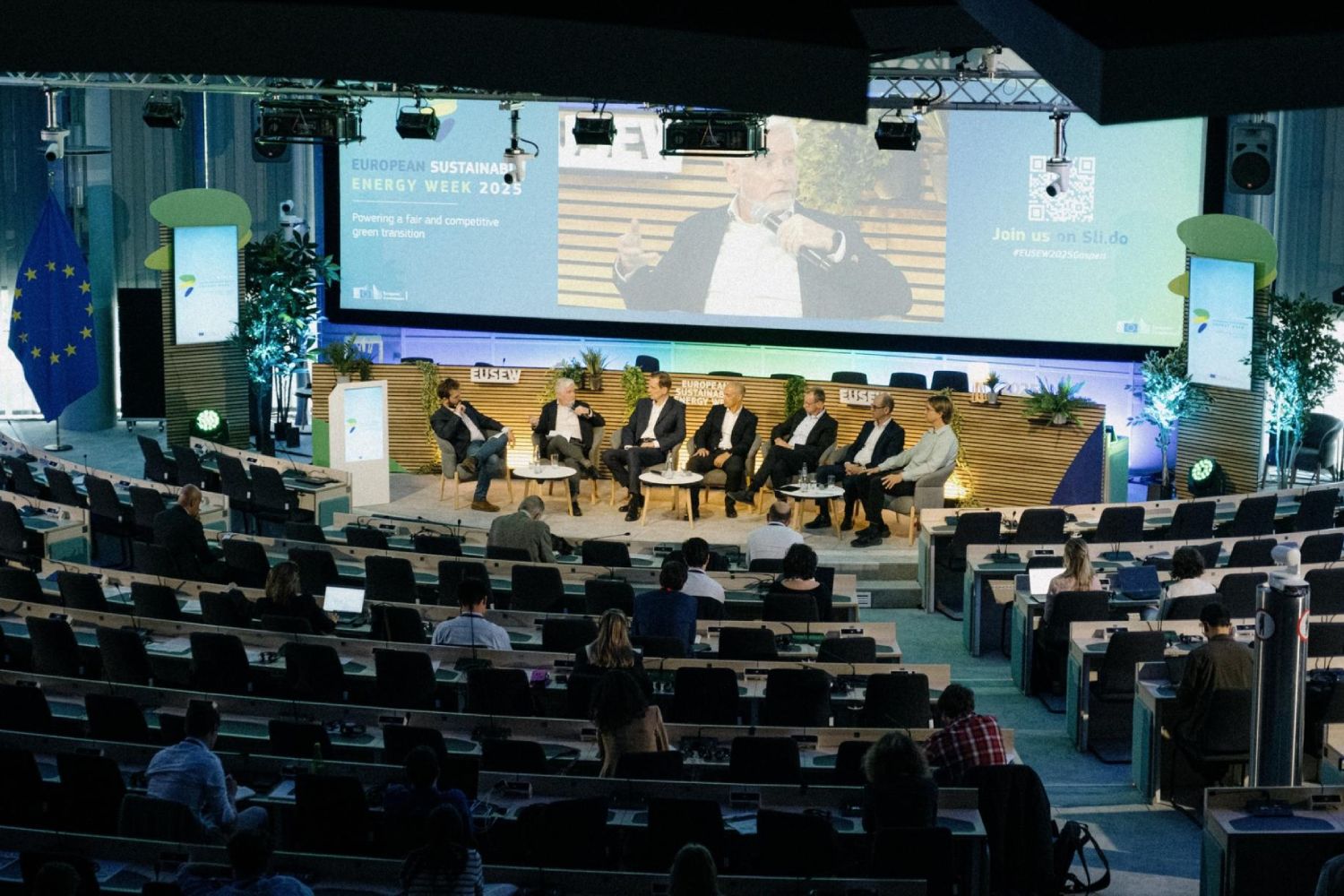
From June 9 to 11, policymakers, industry leaders, researchers, innovators, civil society representatives, and young energy professionals gathered in Brussels for the 20th edition of European Sustainable Energy Week (EUSEW). More than 2,400 participants attended in person, while over 2,200 joined online from 117 countries, reaffirming the event’s significance in the fields of renewable energy and energy efficiency. Together, they shaped three inspiring days of discussion, networking, and collaboration focused on the future of clean energy in Europe. EUSEW has become a cornerstone of the European clean energy movement. Since its launch by the European Commission in 2007, it has evolved into a key platform for dialogue and cooperation regarding EU energy policies and initiatives. It is a premier annual conference organized by the Directorate-General for Energy (DG ENER) in close partnership with the European Climate, Infrastructure and Environment Executive Agency (CINEA). https://sustainable-energy-week.ec.europa.eu/index_en?prefLang=de
Cooling demand and AI are set to trigger the major energy crisis of the future. Forecasts suggest that energy demand for cooling alone could double by 2050, driving up the need for electricity generation massively. Targeted measures are required to prevent a risky cycle of warming and rising energy consumption.
German bioethanol consumption rose by just under 5 percent in 2025 compared to 2024, reaching over 1.3 million tonnes. Please refer to the attached UFOP market data for further up-to-date information on biofuels.
The 9th Rostock Large Engine Conference will take place at the “Hohe Düne” Marina Resort on October 13–14 (event website/program, etc.: https://rgmt.de/) Particular emphasis will be placed on in-depth technical aspects regarding the use of future fuels.
On January 18–19, 2027, the 24th International Conference on Renewable Mobility—”Fuels of the Future”—will bring together around 700 national and international participants at the CityCube Berlin. Leading figures from politics, industry, academia, and practice will gather to actively drive forward the decarbonization of transport by land, water, and air. You are cordially invited to attend under the motto “Shaping Transformation – Clear Path for Renewables.” More information: https://www.kraftstoffe-der-zukunft.com/kongress/nachwuchsfoerderwettbewerb
As reported by “Sustainable Times,” PuriFire Energy has secured support through Innovate UK’s “Investor Partnerships, Clean Energy and Climate Technologies” program. According to the report, this funding provides fresh momentum for the company’s project to convert wastewater into green hydrogen and biomethane fuels in collaboration with Severn Trent. The initiative centers on the company’s proprietary hydrothermal gasification technology, a process currently being evaluated for use in wastewater and sewage sludge treatment facilities. https://www.sustainabletimes.co.uk/post/purifire-energy-joins-forces-with-severn-trent-to-transform-wastewater-into-green-fuel
N. Chandrababu Naidu, the Chief Minister of the Indian state of Andhra Pradesh, has urged the central government to double the cap on ethanol blending in petrol from the current 20% to 40%. He argued that this move would reduce India’s reliance on crude oil imports, conserve foreign exchange reserves, and benefit farmers who cultivate sugarcane and maize. Naidu addressed this request directly to India’s Petroleum Minister, Hardeep Singh Puri, noting that he had already written to the central government regarding the matter. Pointing to countries like Brazil—where ethanol blending rates are significantly higher—the Chief Minister advocated for India to pursue higher blending ratios more decisively in order to strengthen energy security and alleviate the burden of oil imports. He also highlighted Andhra Pradesh’s role as a major maize producer. According to reports, he stated that a higher blending target would substantially boost demand for the crop, given that maize is a key feedstock for ethanol production. Read more on this topic. https://www.chinimandi.com/andhra-pradesh-naidu-pushes-for-40-ethanol-blend-in-petrol/
The global market for bio-based polyurethanes was valued at US$40 million in 2024 and is projected to grow at an annual rate of 9% between 2025 and 2030, reaching US$67.4 million by 2030. “The key growth driver is the rising demand for environmentally friendly materials in the transportation and construction industries, where manufacturers are actively replacing petroleum-based products with bio-based alternatives to reduce CO2 emissions and improve sustainability performance,” the research firm stated. Read more at: https://www.openpr.com/news/4521248/bio-based-polyurethane-market-to-reach-usd-67-4-million-by-2030
The Board of Directors of the Port Authority of Valencia (APV) has granted an administrative concession for the construction and operation of a facility to process and manufacture renewable fuels for handling at the Port of Sagunto. The concession has a term of 25 years and entails an investment of US$23.2 million for the project’s construction and commissioning. The project involves the collection, storage, preparation, treatment, and subsequent processing of waste fats, such as used cooking oils and animal fats. This processing yields advanced biofuels produced via a biomass conversion process. Read more at: https://www.valenciaport.com/en/valenciaport-awards-the-concession-for-a-renewable-fuel-plant-in-sagunto/
Researchers in Switzerland and France are working on a new technology aimed at reducing the cost of producing green hydrogen. Scientists from Empa, working on projects funded by the Swiss National Science Foundation, are collaborating with French research institutions. The goal is to develop more cost-effective materials for electrolyzers—the systems that use electricity from renewable sources to extract hydrogen from water. According to the researchers, the high costs are primarily due to the expensive materials required inside the electrolyzers, particularly in proton exchange membrane water electrolysis (PEMWE) systems. Read more on this topic. https://bioenergytimes.com/researchers-develop-lower-cost-technology-to-support-green-hydrogen-and-bioenergy-transition/
Four of Australia’s most influential agricultural and manufacturing industry associations have called on the federal government to immediately introduce a national mandate for ethanol and biodiesel. They cited the ongoing fuel crisis as evidence of the country’s dangerous reliance on fuel imports. According to the report, the National Farmers’ Federation (NFF), GrainGrowers, Australian Sugar Manufacturers (ASM), and CANEGROWERS—collectively representing more than 150,000 Australian farms and over 16 sugar mills—stated that the time for policy action has come. The four associations are urging the Australian government to introduce an immediate national mandate for ethanol and biodiesel, establish a binding, phased plan to boost long-term demand for domestically produced biofuels, and recognize Australian-made ethanol and biodiesel as low-emission fuels under the federal government’s “Cleaner Fuels Programme.” https://www.chinimandi.com/four-major-australian-farm-and-industry-bodies-unite-to-push-for-national-biofuel-mandate/
Essar Energy Transition (EET) has completed the Pre-FEED (Pre-Front End Engineering Design) phase for one of the UK’s largest centers for the production of advanced sustainable aviation fuels (SAF). The planned Stanlow Methanol-to-Jet (MtJ) project, which will be integrated into the infrastructure of the company’s Stanlow refinery, is expected to produce more than 200,000 tonnes (tpa) of advanced SAF annually, using approximately 550,000 tpa of renewable e-methanol and bio-methanol as feedstock. By locating the MtJ plant at the Stanlow refinery site, the SAF can be blended directly on-site with Essar Energy Transition Fuels’ conventional aviation fuel volumes. Utilizing existing export infrastructure – including access to the Manchester Jet, Midlands and UKOP pipeline systems, as well as existing road and sea distribution routes – Essar states that the SAF can be delivered directly to the UK aviation sector, which includes major airports and airlines. More on the story https://www.essar.com/inthenews/major-step-forward-in-creation-of-leading-methanol-to-jet-sustainable-aviation-fuel-production-hub/
On May 19, the groundbreaking ceremony took place for a high-tech waste treatment and waste-to-energy facility in the commune of Xuan Mai (Hanoi); the total investment amounts to approximately 200 million US dollars. The project is designed to process 2,000 tons of waste daily and feed 45 MW of electricity into the national grid. According to reports, this is the first high-tech facility of its kind in southwest Hanoi—a region that previously lacked large-scale solid waste treatment plants. Read more at: https://vietnamnet.vn/en/hanoi-breaks-ground-on-200-million-usd-waste-to-energy-plant-2517342.html
The Port of Rotterdam Authority, the municipalities of Rotterdam and Schiedam, the Province of South Holland, InnovationQuarter, TU Delft, TNO, and Smart Delta Drechtsteden have joined forces to drive innovation in the hydrogen sector. The new partnership, LAUNCH2, officially launched at the World Hydrogen Summit & Exhibition 2026 in Rotterdam. LAUNCH2 pools the activities of public stakeholders and knowledge institutions to support the development of regional hydrogen value chains in a more targeted and effective manner. Companies can turn to LAUNCH2 for assistance with finding partners, accessing knowledge and infrastructure, and identifying opportunities for testing and scaling up. According to the Port of Rotterdam, the initiative aims to strengthen Rotterdam’s position as a European hydrogen hub. https://www.portofrotterdam.com/en/news-and-press-releases/launch2-gets-underway-alliance-accelerate-hydrogen-innovation
Picture: Resources – European Sustainable Energy Week – European Commission